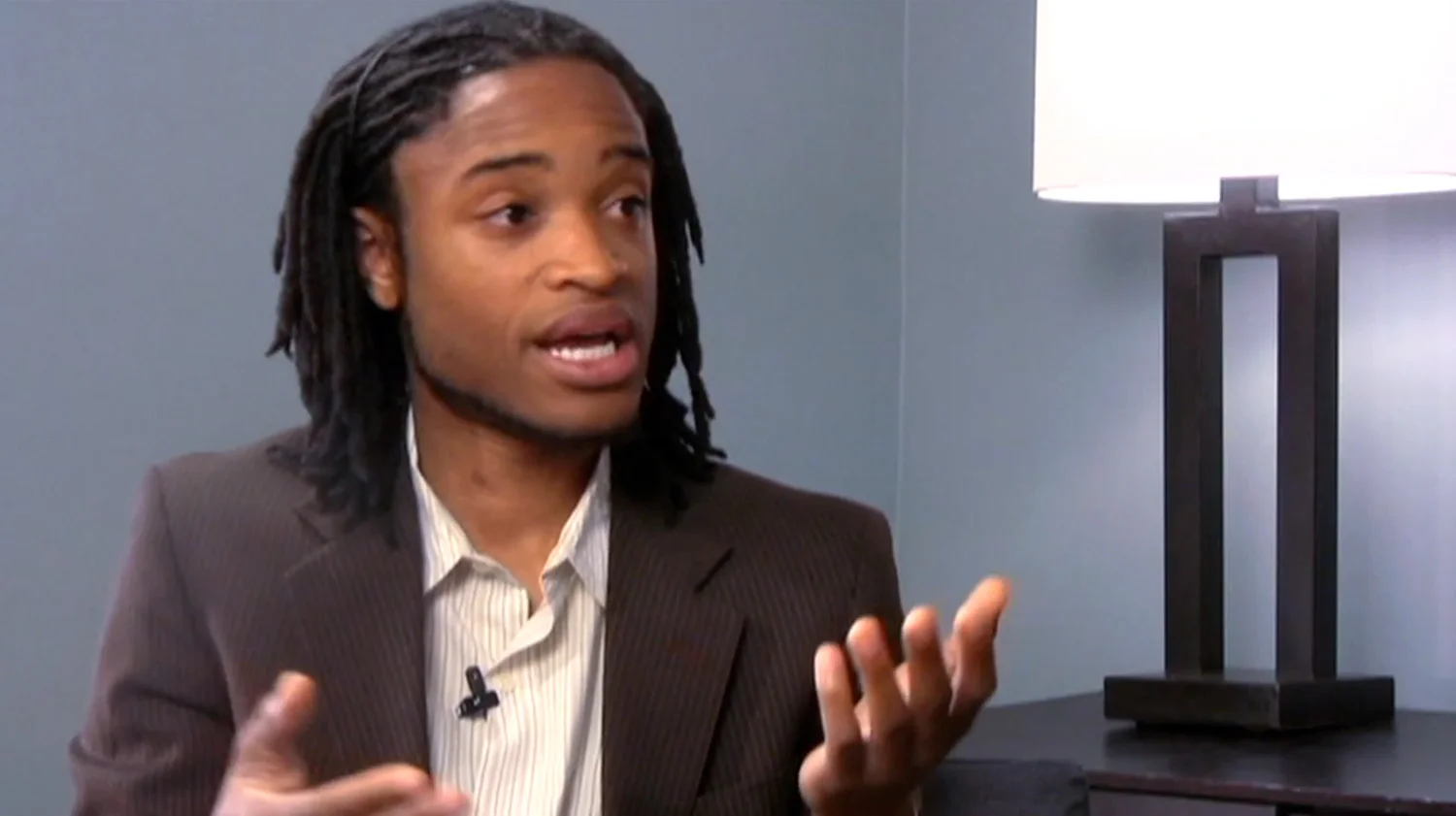
How Journalist Respects Sources Portrayed Negatively in Story - Yoav Gonen

Yoav Gonen returns to Capture Your Flag to build upon his 2009 interview with a 2010 conversation with host Erik Michielsen. In Chapter 5 of 17, Gonen, a New York Post education reporter, shares his approach to dealing with sources that will be portrayed negatively in a story. Gonen notes negative information will be made public and offers sources a chance to say something. He highlights that there are two sides to every story and that, in general, sources normally offer their point of view on what is being reported. Gonen earned his BA in English from the University of Michigan and his Masters in Journalism from New York University.

How Journalist Maintains Credibility When Interviewing Sources - Yoav Gonen

Yoav Gonen returns to Capture Your Flag to build upon his 2009 interview with a 2010 conversation with host Erik Michielsen. In Chapter 4 of 17, Gonen, a New York Post education reporter, shares how he maintains credibilty in his reporting role. He tries to be as open and forthcoming as possible when gathering information and interviewing sources. He finds there is an art to sharing information, however, to get a complete response from a source. Gonen earned his BA in English from the University of Michigan and his Masters in Journalism from New York University.

How Reporter Balances Ethics With Incomplete Information Constraints - Yoav Gonen

Yoav Gonen returns to Capture Your Flag to build upon his 2009 interview with a 2010 conversation with host Erik Michielsen. In Chapter 3 of 17, Gonen, a New York Post education reporter, shares one of the great challenges in journalism, handling incomplete information. Gonen notes it is rare to have complete information, so going to press with a story requires sound judgment that balances need for ethical reporting with need to participate in a competitive news marketplace. He shares one challenge, a high school principal accused of having a drinking problem, and how he went through the decision to research, write and publish the story.

Yoav Gonen earned his BA in English from the University of Michigan and his Masters in Journalism from New York University.

Transcription: 

Erik Michielsen:  As a newspaper reporter, how do you maintain an ethical approach when you may not necessarily have complete information in developing a story?

Yoav Gonen:  Often times, that presents a big problem because there are times when you might be getting conflicting information from different sources, and you can sometimes have an article saying, well this person said this and this person said that.  Sometimes what they say is… might be negative toward someone, and you want to be careful just putting stuff out there because somebody said it.  The constraint you have is that your competitors are probably out there working on the same story and they might be getting stronger information or different information.  There was recently a principal who was removed from a school and there were rumors going around that it had to do… it had something to do that he had a drinking problem.  So, I was hearing this at various levels and at some point it came from reliable enough sources that I felt comfortable putting it in there, but the truth is you can’t know for a100% - I mean these are accusations. 

So, you do hesitate to put this information out there because everyone that picks up a paper is going to read about this guy and read that people are accusing him of having a drinking problem and that is a big deal. You want to cross your T’s and dot your I’s as much as you can.  You reach out to as many people, you make sure you turn over every stone and then at the end of the day you have to decide, “Okay, I’m I comfortable enough with the people that have told me this that I believe them or am I not?”  And then you just got to make the decision.


Why Journalist Embraces the Emotional Intensity of Reporting - Yoav Gonen

Yoav Gonen returns to Capture Your Flag to build upon his 2009 interview with a 2010 conversation with host Erik Michielsen. In Chapter 2 of 17, Gonen, a New York Post education reporter, shares why he finds the emotional intensity interviewing people for news stories so appealing. Gonen, who did not grow up in an emotionally intense family, is drawn to the emotional range - the highs, the lows, in his reporting role at the New York Post newspaper, where he covers education across New York City. Gonen earned his BA in English from the University of Michigan and his Masters in Journalism from New York University.

How Muslim High School Girl Inspires Education Reporter - Yoav Gonen

Yoav Gonen returns to Capture Your Flag to build upon his 2009 interview with a 2010 conversation with host Erik Michielsen. In Chapter 1 of 17, Gonen, a New York Post education reporter, shares why the human element in his reporting makes his job so fulfilling. Gonen regularly meets people in extraordinary circumstance and gets to tell their stories. In one instance, a young Bangladesh-born Muslim girl living in New York overcomes family and cultural obstacles to study her passion, biology, while in high school. Gonen details his experience discovering, researching, and writing the story that ultimately ended with the Muslim girl receiving a scholarship to study at Cornell University. Gonen is a University of Michigan graduate and also earned his Masters in Journalism from New York University.

Jullien Gordon on How Aligning Mind With Time Turns Passions into Skills

In Chapter 14 of 14 of his 2010 Capture Your Flag interview, motivation teacher Jullien Gordon shares the importance of identifying skills and the accumulation of hours already invested. To crystallize a passion into a skill, defined as an experience or outcome you can replicate better than an average person, Gordon pushes coaching clients to invest time in building that experience. Gordon references author Malcolm Gladwell's 10,000 Hour rule - known as "practice time" - detailed in his book "Outliers" as one way aligning one's mind with time turns passion into skills and competitive advantage. Gordon holds an MBA and Masters in Education from Stanford University and a BA from UCLA.

Transcript:

Erik Michielsen:  How do you coach others to align their mind with their time to put turn their passions into skills?

Jullien Gordon: Even though this isn’t Gladwell’s theory, it came up in his book “The Ten Thousand Hour Rule”.  I really get people to – The ten thousand hours is basically 20 hours a week, 50 weeks a year for 10 years.  So, whatever it is that you want to position yourself as an expert at, you have to set aside at least 20 hours a week for 50 weeks a year for 10 years to make that happen.  In reality because I think we’re always moving toward our purpose, whether we know it or not, the challenges that we are facing are only moving us toward our purpose, and the happiness that we’re experiencing is because we’re in line with our purpose. 

Many people already have thousands of hours accumulated, but they weren’t aware that they were actually developing some sort of skill.  You doing these interviews, you being on your forty-fifth interview over the past year, all of that is accumulation of hours toward some sort of skill set that you’re developing.  You might not even have the language around it yet – I know we talked about leadership skills and development – but we are always developing, developing, developing. So, it’s really about crystallizing your passion into a skill.  A skill is basically something that you can replicate more frequently than someone who isn’t as skilled.  So, the only reason that people are getting paid millions of dollars to play on the Yankees is because they can hit an 80 mph fast ball better than you and I can.  They can replicate that experience better than you and I can.  And that’s what a skill is, being able to replicate a particular experience or outcome better than the average person.


Jullien Gordon on How Experience Checklist Empowers College Student Career Planning

In Chapter 13 of 14 of his 2010 Capture Your Flag interview, motivation teacher Jullien Gordon tours 30 college campuses in 10 weeks to provide guidance to students finding difficulty finding jobs. Gordon cites how only 20% of graduating college students have jobs and creates a novel approach, a 66-item list, to build student intellectual, personal, financial, and social capital. The National Society of Collegiate Scholars (NSCS) backs Gordon and his effort to complement the career planning, curriculum, and counseling students receive while in school. Gordon holds an MBA and Masters in Education from Stanford University and a BA from UCLA.

Transcript:

Erik Michielsen:  How did your thirty college, ten week speaking tour, Route 66, reshape your ideas on how to reform college career planning?

Jullien Gordon:  Oh, man.  So, I did this college tour called the Route 66 in partnership with the National Society of Collegiate Scholars, went to thirty campuses in ten weeks all across the country.  It was amazing.  Reached thousands of students and as – the tour was based on sixty-six things that a college student needs to do before graduation because I woke up one morning and saw a statistic from the National Association of Colleges and Employers and said only 20% had jobs on hand at graduation.  So, college use to be this guaranteed path to a job and you’re telling me that only 20% of college graduates in the class of 2009 had job at graduation?  That tells me that college isn’t doing what it’s suppose to, and for me college is a four-year stepping stone for your forty year career.  So, out of that I was inspired to list all the things that I think would help students develop their personal, intellectual, social and financial capital during college to position themselves for the career that they wanted after.  It ended up being a list of sixty-six things and as I was sharing this with them on this tour during this ninety minute presentation, I would say, ‘How many people have done this?” And only two people would have done any given item on the list. 

They were being exposed to things that they had never considered using the college environment for in that space and it just showed me that there was a huge, huge gap.  That the career center wasn’t giving it to them, their major counselor wasn’t giving it to them, their classes weren’t giving it to them, their extracurricular activities wasn’t giving it to them and that they all need it packaged it in one space and that’s what the Route 66 is all about.  I touch base with some of the students on Facebook saying, ‘How’s your Route 66 going?” “I’m crossing off my things off one at a time and I’m so glad that you came to campus and shared this with me.”  And I truly believe that any student that graduates having taken Route 66 is going to be ten times more ready for the world than any student that hasn’t.


.

Jullien Gordon on How Dashboard Tool Improves Goal Planning and Achievement

In Chapter 12 of 14 of his 2010 Capture Your Flag interview, motivation teacher Jullien Gordon shares why creating a dashboard is helpful in managing success metrics contributing to goal planning and achievement. Gordon emphasizes dashboards to overcome pitfalls of adopting societal success - fame, money, power - or family success - parent suggestions - to personalize goals at the individual level. By choosing the right variables and monitoring them over time, Gordon pushes those he teaches to maximize their performance. Gordon holds an MBA and Masters in Education from Stanford University and a BA from UCLA.

Transcript:

Erik Michielsen:  Why do encourage people to create personal dashboards and why are they helpful?

Jullien Gordon: If you try to drive a car without a dashboard a lot of things can happen.  You can get a speeding ticket. You can run out of gas.  You can be overheating. So, I think if we don’t create our own dashboard for success, we just adopt society’s dashboard, which is wealth, fame, beauty, etc.  And so you can end up moving the needle on all those metrics and still be unfulfilled because it doesn’t align with your personal dashboard, and I think from generation to generation, especially the dashboards change drastically.  So, if you were living a life based on your parents’ dashboard of success, even though your parents want the best for you and they are the ones pushing you into a particular career path and certain decision, they want the best for you but they want the best for you based on their dashboard.  So, it’s important to define our own dashboard and our own metric of success and then live a life that moves those needles every single day.


.

Jullien Gordon on Why a Modern Resume Should Be More Portfolio and Pitch Than Paper

In Chapter 11 of 14 of his 2010 Capture Your Flag interview, motivation teacher Jullien Gordon shares why the traditional resume is dead and what should be included in a modern resume. Gordon focuses on value creation, not job responsibilities. The resume should communicate the value you create wherever you go. He also believes the next generation resume should not be a one-sheet resume; rather, it should be a pitch complete with a portfolio of previous projects. Gordon holds an MBA and Masters in Education from Stanford University and a BA from UCLA.

Transcript:

Erik Michielsen: How do you define the modern resume?

Jullien Gordon: The resume 1.0 is dead.  There is just so much information A-symmetry in the career search process.  A lot of people think of resumes as a job description, ‘I’m going to take the job that I did and I’m going to put the job description as the bullet points.’ But at the end of the day, what you really want to show an organization is how you moved something within that organization from point A to point B.  So, this is not your job description and what you did on a daily basis, but what value you created while you were actually at that organization.  They could care less about the education – the school you went to and your GPA.  That might get you in the door and decrease that barrier to entry but at the end of the day your resume should communicate the value you create wherever you go. 

In addition to that I also believe in this notion of the resume 2.0.  It’s more of a – it’s in the same way that business do these ten slide decks.  I think you should have a deck about who you are, what your purpose is, what your passions are, how you create value, what problem you are committed to solving, everything that’s a part of the 8 Cylinders of Success, and you should also have a portfolio of your best work.  That can be a business plan that you wrote in school.  It can be a paper that you wrote in school.  It could be an even that you coordinated.  When you go to an interview, instead of coming with this one sheet resume, you should come with your entire portfolio and lay that out on the table and say, ‘This is how I’ve been creating value at all the organizations and spaces I’ve been in the past five years and this is what I can bring to your organization.’ That alone, bring your portfolio and your resume 2.0 and your resume 1.0 written in the value creation way will set you apart from any other candidate.


.

Jullien Gordon on How to Use Bridge Jobs to Develop a More Rewarding Career

In Chapter 10 of 14 of his 2010 Capture Your Flag interview, motivation teacher, Stanford MBA and entrepreneur Jullien Gordon shares why bridge jobs - short term 40-hour per week jobs that last 12-18 months or allow you to save six months savings - facilitate a better planned, and ultimately rewarding, career. Gordon also highlights how a bridge job increasing short term contribution and engagement, given the deadline is known. Gordon continues by sharing how today's workforce no longer relies on one career employer and that given the high number of jobs individuals will have, the workforce must get embrace change.

Transcript:

Erik Michielsen: What are bridge jobs and how have you used these in developing your own career?

Jullien Gordon: Bridges jobs is a concept that I created that it’s basically a job that helps you get to point A to point B and some of the principles is that it’s eighteen months or shorter or six months of savings – savings being covering your coast of living for six months.  So, coming out of business school I wanted to be an entrepreneur but the company that I was creating at the time wasn’t ready to support me.  So, I took a bridge job at a non-profit organization.  Another key principle of bridge jobs is that it only works you forty hours a week so that you have the other forty to sixty hours of your week to create what you want to create. 

Because a lot of people say, ‘Oh yeah, I want to go work and then I want to become an entrepreneur.” But they’re working sixty to eighty hours a week and they’re too tired to contribute or invest time in real good energy into what they ultimately want to do.  So, I took a bridge job.  I was at an organization that I love called Management Leadership for Tomorrow, working there for seventeen months, which is where I met my six month savings goal in January 2009, in the middle of the financial crisis.  I just left and stepped into my path as the CEO of the Department of Motivated Vehicles.  So a bridge job is so important because another beautiful thing about bridge job is when you set a time period, in terms on when you’re going to leave, rather than saying, ‘Oh, I’ll leave when the time is right.”  When you set a time you actually start maximizing that opportunity because you see that end of the tunnel.  So, you start developing the relationships with customers, future customers or with people within the organization, you’re more intentional about developing your personal, intellectual, social, financial capital because now you’re trying to get the most of that opportunity in this short, condensed amount of time. It’s Parkinsen’s Law, work will expand to fill space but if you condense the space you realize you can get equally as much work done.

I really encourage people who are considering changing their careers or stepping into entrepreneurship to really look at their current opportunity as a bridge job.  Set a time stamp on it or a savings goal and then just commit to making that transition. In the video “Shift Happens” which is a video online about globalization, it says that by the age of thirty-eight our generation is going to have 10-14 careers.  So, this whole notion of being with one company for your entire life no longer exists, just get that out of your mind unless you’re creating the company.  Even then, Steve Jobs went from Apple to Pixar and back to Apple so this whole notion with one job for the rest of your life doesn’t exist and we have to get comfortable with change.


Jullien Gordon on Why Groupthink Limits MBA Student Potential

In Chapter 9 of 14 of his 2010 Capture Your Flag interview, motivation teacher and Stanford MBA Jullien Gordon shares why groupthink limits so many MBA career plans. During his MBA, Gordon was stunned to see a group of extremely talented and passionate classmates focus on a limited set of career options, namely brand marketing, management consulting, investment banking, private equity and venture capital. Gordon implores MBA students to focus first on applying their passions toward solving the biggest problems rather than making the most money. Gordon references a young Bill Gates and how that problem solving - getting a computer in every home - translated to later career philanthropic efforts. Gordon holds an MBA and Masters in Education from Stanford University and a BA from UCLA.

Transcript:

Erik Michielsen:  How does group think limit MBA student potential and why is this a problem worth solving?

Jullien Gordon:  Oh my goodness! So, I wrote this blog post recently called “A Letter to an MBA” and it came after sitting at a panel at Columbia Business School and just realizing – and I went to Stanford and when you think about the admission rates there. These are literally the most talented – some of the most talented people in the entire world – 350 of the most talented people, and it just makes no sense to me how 350 of the most talented people can all want to be the same five things.  They all want to consultants, bankers, private equity marketers, whatever.  And it just makes no sense to me. 

Instead of thinking of the career paths based on the recruiters that come to campus and what makes the most money, really what MBAs should be thinking about is ‘What is the biggest problem I can solve in the world?’  When you look at Bill Gates, that was the question he asked himself. “How do I get a computer in every single home?”  And what Bill Gates has done is, instead of – he really is a problem solver, technology was the one avenue that he explored his purpose but at his core he’s a problem solver.  Now, he’s taking his problem solving ability and taking it to Malaria, education equalities and other health issues in the developing world because at the core he’s a problem solver. So, if MBAs thought of their career paths in the sense of “What is the biggest problem that I can solve in the world?” then I think that could transform the world in general.


Jullien Gordon on Why Underemployment Limits Career Potential

In Chapter 8 of 14 of his 2010 Capture Your Flag interview, motivation teacher Jullien Gordon shares why underemployment, where employees are not engaged, using their passions, and reaching their potential. Gordon believes that creating clarity of purpose allows individuals to align with the right professional role and create the most value. Gordon holds an MBA and Masters in Education from Stanford University and a BA from UCLA.

Transcript:

Erik Michielsen:  What is underemployment and why do you see this as being such a massive problem today?

Jullien Gordon:  Oh, man! Underemployment is the biggest problem in the world today and I’ll tell you why.  A lot of people think unemployment is the metric for a bad economy, right?  But if you look at the economy only 10% are unemployed, and that’s a lot of people, but when you think about it – when you look at research from Gallop and other statistics, in fact 50% of employees are underemployed.  Which means that they are not using their passions, they’re not reaching their full potential, they’re not making the highest contribution, therefore they’re definitely not creating the most value possible for the organization that they’re in.  A lot of us don’t even know how we end up on certain career paths, we just know we’re not happy there.  You probably hear once a day people say, ‘I have my job.’ Right?  You just look at people on the subway you know how many people hate their jobs.  The actual economy suffers when you have somebody who actually wants to be a teacher being a consultant, right? When you have somebody who really wants to be a healer or a doctor being a banker.  So, you people misplaced. 

I call it ‘Career Music Chairs’ where people are bouncing around musical chairs and nobody is in the seat where they can create the most value in.  So, that’s why I think underemployment is the biggest issue that we face as an economy, but it gets overlooked because it’s like ‘You know what? People have jobs, so they’re good.”  But when you look at the emptiness that they are facing and knowing that they’re not happy at work.  When they – going back to when they’re not happy, therefore the customer isn’t getting the best service, therefore the company and the investors aren’t getting the greatest return on their invest and it just starts this loop.  So, we have to get people aligned with their purpose and professions, so going back to the quote, ‘A man who knows his why can bare almost any how.”  When you have somebody who is in a professional path where they are clear on their purpose and that they can be themselves in that space, that’s when they’re going to create the highest amount of value.


Jullien Gordon on How Stanford Grad Uses MBA and Education Masters Degree in Career

In Chapter 7 of 14 of his 2010 Capture Your Flag interview, motivation teacher Jullien Gordon shares why he chose to earn both a masters in education and a masters in business administration (MBA) from Stanford University. Coming out of college at UCLA, Gordon works for Students Heightening Academic Performance Through Education (SHAPE). There he learns his passion is education, but not of the classroom type. Gordon chooses to attend Stanford to craft a career as a motivation teacher, using education classes to provide the tools, systems, and processes to help people self motivate and learn. He pairs this with business school knowledge - marketing, finance, etc. - to create value and make a living doing what he loves.

Transcript:

Erik Michielsen:  What motivated you to purse dual master degrees in education and business administration when going back to Stanford University?

Jullien Gordon: Coming out of UCLA, I was committed to – I was working at an education outreach program called The Shape Program – and so my passions were both in education and business but I never saw myself necessarily in the educational system but I really wanted to understand – the education degree was to understand how people learn and the business degree was to how to create value, and that’s what I do. I’m a motivation teacher now.  So, I teach people – not a motivational speaker.  A motivational speaker comes and get you excited, “Rah, Rah” and as soon as they leave all the energy dies.  As a motivation teacher, I leave people with tools, systems and processes that allow them to motivate themselves and self motivate.  So, I’m a teacher and I understand how people learn and how they consume information and what sticks and on the business side, that just gives me the skill set to make a living doing what I love.


Jullien Gordon on How Understanding Purpose Increases Probability of Success

In Chapter 6 of 14 of his 2010 Capture Your Flag interview, motivation teacher Jullien Gordon shares how clarity of purpose, or why you do what you do, increases your commitment and probability of success. Gordon highlights "The Drive" author Daniel Pink's work to understand intrinsic motivational tools, in particular purpose. Gordon holds an MBA and Masters in Education from Stanford University and a BA from UCLA.

Transcript:

Erik Michielsen:  How do you use ‘Why’ as a driving factor in structuring actual commitment in what you do and teach?

Jullien Gordon:  Definitely.  So, I always start with the ‘why’.  One of my favorite quotes is, ‘The X Factor to success is knowing your why.”  The clearer you are on your reason or your why or your purpose for doing anything the more likely you are to succeed.  So, rather than setting up all these incentives and things like that, I think the best thing is to help the individual get clarity on why this is important to them and to the other people that it’s going to affect and that is going to be the primary driver and motivator.  In Daniel Pink’s book “The Drive” he talks about these false motivators and how they can actually work as disincentives instead of incentives, though that’s how corporate organizations work.  So, purpose is one of the things that he has found as the key motivator of people – once people feel purposeful about something, you can step out of the way.  You don’t need to do anything else because their commitment is already built in.  Their intrinsic motivation is tapped in and intrinsic motivation is always better than extrinsic motivators.


Jullien Gordon on How to Increase Personal Potential Using a 30-Day Goal Framework

In Chapter 5 of 14 in his 2010 Capture Your Flag interview, motivation teacher Jullien Gordon shares why he pushes others to achieve goals in 30-day increments. This is part of his "30 Day Do-It" program, that uses accountability controls to push participants beyond their perceived limits and move toward reaching their full potential. Accountability controls, costs, are designed to tip scales on the cost-benefit analysis we all use for intrinsic motivation. Gordon uses creative applications to then motivate program participants to execute on plans within predetermined deadlines. Gordon holds an MBA and Masters in Education from Stanford University and a BA from UCLA.

Transcript:

Erik Michielsen: Why do you push people so hard to achieve goals in thirty-day increments?

Jullien Gordon: Well, you’ve heard the quote, “If you love something, let it go. If it comes back to you, then it’s yours.”  I don’t believe that. [laughs]  I believe if you love something you should push it and if it comes back then you should push it harder.  It has been my understand that it’s not till you push something to it’s perceived limits, like say this table is the limit, that it actually realizes that it’s limitless.  A lot of us actually confine ourselves in what we think is possible for our lives. So, I’m willing to take a stand for the people that come to me, to push them beyond their own perceived limits of who they are because I believe we are infinite beings and I want to see people reach their full potential and I can see potential in them that they don’t necessarily see in themselves.  So, I just challenge them to expand who they are and that’s why I challenge them to do as much as they can in these thirty-day increments. 

Erik Michielsen: What tools do you use to hold others accountable for their actions?

Jullien Gordon:  The biggest part in 30 Day Do Its is actually creating a cost.  So, what I’ve actually discovered is when you have a cost-benefit analysis, if the cost out weighs the benefit you don’t move, if the benefit out weighs the cost you move.  In most cases when we set goals, the cost and benefit are equal.  The benefit of saying I wrote a book verses the cost the one-hundred hours it going to take to write that book are pretty equal, but if you tip the balance and you increase the benefit or add more cost it actually gets people move because now they have to make a choice.  By not moving, they can’t stay in the same place.  So, they know that they go backwards.  So, I bet my friends who want support from me and accountability, I said, “Okay. Write me a check for $100 right now and give it to me and if you accomplish the goal I’ll rip it up and if you don’t, I’ll cash it.”  So, that’s how I get people to move forward on their journey.


Jullien Gordon on How Auschwitz Concentration Camp Story Inspires a Life of Purpose

In Chapter 4 of 14 of his 2010 Capture Your Flag interview, motivation teacher Jullien Gordon finds inspiration and purpose, his "why", by reading Viktor Frankl's book, "Man's Search for Meaning." Specifically, Frankl's quote, "Nietzsche's words 'He who has a why to live can bear with almost any how'" helps Gordon align his why, or purpose, when pursuing goals, no matter how challenging. The book chronicles Frankl's time as an inmate at the Auschwitz Concentration Camp during World War II and details his quest to find reason, or meaning, to live.

Transcript:

Erik Michielsen: How has Victor Frankl’s quote “A man who knows his why can bear almost any how” reflected in your own sense of purpose?

Jullien Gordon:  I read that book A Man’s Search for Meaning in high school, it was in a class called Living and Dying and that quote just stuck out to me [asks Andrew a question] So I read that quote… I read Man’s Search for Meaning in high school in a class called Living and Dying and that’s where that quote came from and so for me your Why is your purpose, right? And so when you are clear, crystal clear on what it is your purpose is no matter what obstacles stand in your way in terms of living in alignment with that, you can over come them and of course Man’s Search for Meaning was about being… stuck and trapped in Auschwitz and how his ‘why’, which was a love of his family, helped sustain him during that try, trying time and so when you are clear of your ‘why’ and your reasoning for being in your own self worth, no matter what obstacles come your way you actually over come them.

Jullien Gordon on How Stanford MBA Creates His Own Career Path

In Chapter 3 of 14 of his 2010 Capture Your Flag interview, motivation teacher Jullien Gordon learns from an alcoholic parent that choosing from a career option menu is not the only way. Instead, Gordon creates his own career path as a motivation teacher and purpose finder. Gordon believes we all have the capacity to create our own careers. Most importantly, Gordon advises others to pursue a career where you answer "What do you do?" with "I'm just me all day." Gordon holds an MBA and Masters in Education from Stanford University and a BA from UCLA.

Transcript:

Erik Michielsen: What did your mother’s battle with alcoholism teach you about self-education?

Jullien Gordon: In the past generations they were under the premise that ‘go be a teacher, doctor, lawyer, engineer ’ and you’re just guaranteed success and happiness and so people were actually choosing from a menu of career options rather than exploring who they are and who they wanted to be and coming out of business school at Stanford, I realized that ‘You know what? I’m looking on all these recruiters coming to campus and things like that and I don’t see myself – see any opportunities for me to step into one of these organizations and actually be myself’ and I had to carve out or create a career path that I wanted to be – that I wanted and so that’s where the notion of purpose finder came in, I mean how many purpose finders do you know? Right? So, it was a career path that I created. 

I think the number of career paths that are actually in the world are exactly correlated to number of people in the world, right? But instead we try to fit ourselves into these boxes, ‘I’m a marketer. I’m a banker. I’m a consultant. I’m a teacher.”  When at the end of the day, the best career is the one where you can say – when someone asks you, ‘So, what do you do?’ – ‘I’m just me all day.’  That’s really what we want and so – but you have to have self awareness or else that fear and that gap will force you or cause you to choose something you think you know.  Because many times we don’t even know the career path that we say we want to be.

Jullien Gordon on Why to Use Alcoholic Anonymous Model for Personal Development

In Chapter 2 of 14 of his 2010 Capture Your Flag interview, motivation teacher Jullien Gordon shares why Alcoholics Anonymous and its flat, sustainable, results-oriented, and empowering personal development model defines his own leadership style. Not only does the model promote accountability at the individual level, but also Gordon finds that personal development is most transformational in group settings. Gordon looks past the one-time personal development experience provided in conference settings to group settings that provide sustainable guidance and monitoring. This has led Gordon, who graduated from Stanford with an MBA and Masters in Education and earned a BA at UCLA, to start his "Career Change Challenge".

Transcript:

Erik Michielsen: What defines your leadership style and how would you like to evolve it?

Jullien Gordon: Alcoholics Anonymous defines my leadership style in terms of wanting to build a very flat, flat organization where everybody feels like a leader. I think AA from a personal development standpoint is transforming more lives than any other personal development organization out there today. When you look at the personal development usually there’s a guru on stage speaking to the masses and AA just flips that entire model on it’s head. It’s more sustainable, I think it’s more empowering and leads to more long term results than the traditional models of personal development and that’s where the Thirty Day Do It Movement comes in.

You have a group of people who care about you and you step into that group and you set a goal.  But, when you set that goal you also create a cost. So, that cost might be, ‘I’m going to give everybody in this group $50 if I don’t accomplish that goal.  I’m going to wash everybody’s car with a toothbrush if I don’t accomplish this goal.”  Whatever it is that is going to be embarrassing but bearable, right?  So, when you create that cost your likelihood of you achieving that goal increases and now you have people that care about you holding you accountable.

Erik Michielsen: How have you applied the Alcoholics Anonymous model to help others plan careers?

Jullien Gordon: One notion that I have is that personal development isn’t personal, right? And we have this idea of personal development being ‘I get this book, I read it, go in the corner of a room, I read it, then I’m transformed’ but then if the world around you doesn’t change then the likelihood of regressing is a lot easier and when you have a powerful group of people moving forward together I think you just have a better outcome rather than people trying to do it on their own.

Again with the personal development industry you go to this conference and then you meet all these great people there, but then you fly back to home or you back to your own world and you step into your family, your work environment and nobody knows the language and things that you’re talking about and therefore it’s so easy to go backwards and so when you have a group of people who is there to support you and understands the language you’re talking and understands the systems and processes that are behind you I think that that’s where you actually can have the most power results.

And so the next thing on the plate for me is actually something call the Career Change Challenge and it’s going to be a seventy-day tele-seminar where groups of people are being guided through a process to change their careers and so again… again it’s groups not individuals because I just feel like I can have more impact by empowering groups of people than I can by empowering one person. Now, every life is equally valuable but I think that there’s a collective wisdom that you tap into when you are actually moving in a group.